
Holding Company: How It Works, Benefits, and Examples
The short version A holding company owns interests in other businesses or assets. An operating company runs business activities. A holding company may be an LLC or a corporation; the…
Written by Spiegel & Utrera, P.A.
- Published
- November 19, 2026

The short version
- A holding company owns interests in other businesses or assets. An operating company runs business activities.
- A holding company may be an LLC or a corporation; the name describes its role.
- You may be able to build around an entity you already own.
- Formation charges apply only to new entities—not entities marked as already existing.
- Ownership changes require appropriate implementation. A diagram does not transfer ownership.
- Privacy, asset separation, and succession benefits depend on the structure and jurisdiction.
What is a holding company?
A holding company is a company whose role is to own interests in other companies or assets. An operating company carries out activities such as selling products, providing services, and employing staff.
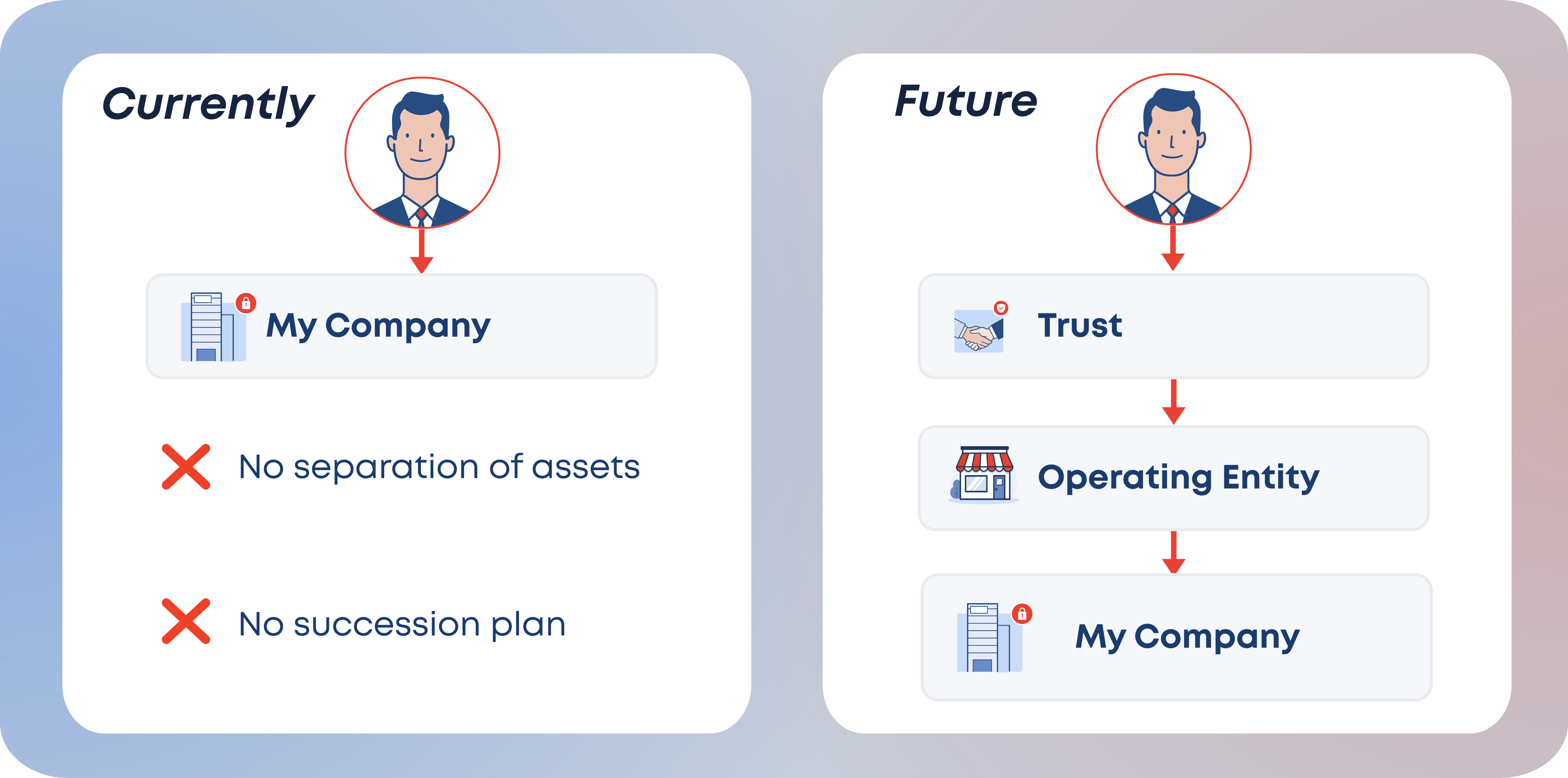
For example, an owner could hold an interest in a holding company, which in turn owns an operating company. Importantly, the holding company and operating company remain distinct entities.
In other words, “holding company” describes a role rather than a single legal form. A holding company might be organized as an LLC or a corporation, subject to the requirements of the proposed arrangement. Meanwhile, “subsidiary” describes a company controlled by another company; an operating company can also be a subsidiary.
However, legal ownership and federal tax classification are separate questions. The IRS explains that an LLC’s federal tax treatment depends on factors such as its number of members and any tax election. Therefore, adding an ownership layer does not, by itself, guarantee tax savings. [1]
Holding company vs. parent company
A parent company controls another company, called a subsidiary. A holding company focuses on holding ownership interests or assets. In fact, the terms can overlap: a holding company that controls subsidiaries is also a parent company.
Ultimately, the distinction is what the company does. A parent may operate its own business while controlling subsidiaries; a pure holding company focuses on ownership rather than day-to-day trading.
As a result, the useful questions for your structure are who owns each entity, which entity conducts business, and where the assets and obligations belong.
Can you use your existing business?
Often, yes. An existing business may become owned by a newly formed holding company without being formed again. However, the ownership change requires appropriate documentation, approvals, and tax review.
For example, suppose you already own an operating LLC and want to explore greater ownership privacy. In the builder, you can select the anonymous holding structure, mark your operating LLC as already existing, and add a proposed holding company above it.
Formation charges apply only to new entities being created—not entities marked as already existing. Ownership transfers, amendments, additional services, and ongoing obligations are separate considerations and may involve additional charges.
However, drawing the relationship does not transfer ownership. Likewise, forming the holding company does not complete that transfer. Before implementation, review the existing entity’s ownership documents, tax status, contracts, financing, licenses, and any required consents.
Moreover, this distinction matters beyond LLCs. For example, businesses taxed as S corporations have restrictions on eligible shareholders. A proposed entity or trust owner must be checked against those rules before a transfer occurs. [2]
Compare structures by your goals
There is no single best structure for every business. First, identify the problem you want to solve. Then compare the ownership arrangements that could address it.
| Your goal | Framework to explore | Main consideration |
|---|---|---|
| Greater ownership privacy | Anonymous holding structure | What information each jurisdiction and institution requires |
| Succession and continuity | Trust holding structure | Trust terms, eligible ownership, and properly completed transfers |
| Separating ownership from operations | Holding company with an operating entity | Where assets, contracts, liabilities, and ownership interests sit |
| Organizing additional ventures | Holding company with subsidiaries | Whether companies should sit beside one another or in a chain |
| Organizing multiple properties or activities | Master series LLC | State-specific availability and separation requirements |
| Planning a cross-border startup | Customized international structure | Investor requirements and coordinated legal and tax advice |
| Investing retirement assets through an LLC | Checkbook IRA arrangement | IRA ownership, custody, and prohibited-transaction rules |
In short, these are starting points for planning, not assurances that a preset is suitable for your business.
Holding company structures and examples
1. Anonymous holding structure: exploring ownership privacy
An anonymous holding structure is an ownership arrangement intended to reduce the visibility of an individual’s ownership in certain public business records, where permitted. It does not make the owner untraceable.
AmeriLawyer’s preset illustrates a Wyoming holding LLC above a Florida operating LLC. However, this is one proposed configuration to explore, not a universal recommendation.
Importantly, public filing requirements differ. Wyoming’s standard LLC articles, for example, request organizer, registered-agent, and address information without a separate member-list field. Nevertheless, that does not establish what every other filing or institution will require. [3]
For an existing business, review what is already public and what future filings will show. Furthermore, adding a holding company does not erase old records or eliminate applicable ownership-disclosure requirements.
Start with this question: Which specific public records are you trying to address?
2. Trust holding structure: planning for succession
A trust holding structure uses a trustee, acting under a trust agreement, to hold business ownership interests directly or through a holding company.
As a result, this can help organize who will manage those interests and how they will pass to beneficiaries. The builder illustrates a trust above a holding company and an operating company; the legal documents must establish the actual arrangement.
A trust’s potential probate benefit depends on proper funding and applicable law. The Florida Bar explains that assets must be transferred appropriately to the trustee; assets left outside a revocable trust may still require probate. Therefore, simply creating a trust or adding it to a diagram is not enough. [4]
Start with this question: Who should manage and receive your business interests if you cannot manage them yourself or after your death?
3. Holding company with an operating entity: separating roles
A holding company structure separates the role of owning a business from the role of running its operations.
Here, the key planning question is where each asset and obligation belongs. If valuable equipment remains in the operating entity, adding a parent company does not move that equipment elsewhere. Consequently, a diagram should distinguish ownership of the company from ownership of its assets.
For example, you might explore whether a business’s premises and its day-to-day operations should be held separately. However, that requires examining the proposed asset ownership, contracts between entities, financing, insurance, and tax consequences.
Even so, asset separation is not a guarantee against claims. The arrangement must be appropriate, properly documented, and maintained in practice.
Start with this question: Which assets and activities are you trying to separate, and why?
4. Holding company with subsidiaries: organizing growth
A subsidiary structure places one company under another company’s control. It can help map ownership as a business adds ventures or activities.
For example, there are different ways to arrange that ownership. A holding company might own two operating companies directly. Alternatively, a holding company might own an operating company that owns another subsidiary—the chain shown in AmeriLawyer’s preset.
However, those arrangements are not interchangeable. In particular, where you place a new venture affects which entity holds its ownership interest and which documents govern the relationship.
Use the builder to compare possible arrangements before choosing one. After all, a new brand or product does not necessarily require a new entity; the decision should reflect a real operational, ownership, or planning need.
Start with this question: Should the new venture be owned by your current operating business or separately under a common parent?
How AmeriLawyer helps you plan
Fortunately, you do not have to arrive with a finished ownership plan.
- Choose a goal. Identify whether privacy, asset separation, succession, growth, or a specialized investment need is driving the decision.
- Choose a preset or build your own. Start with a framework or add companies and trusts from scratch.
- Include what already exists. Mark your existing entities accordingly so they are distinguished from new formations.
- Customize the proposal. Rename entities, select states, and add or remove entities to see how they connect.
- Review implementation. Discuss suitability, transfers, required approvals, tax treatment, and continuing obligations before putting the plan into effect.
Build on the business you already own. Explore what comes next.
Explore the Business Structure Builder
Contact our team to discuss the right ownership framework for your business.
Need help choosing a starting point? Contact AmeriLawyer / Spiegel & Utrera, P.A. to discuss your goals.
Holding company FAQ
Do I need to form my existing company again?
No. In AmeriLawyer’s builder, mark it as already existing. Formation charges apply only to new entities being created. Changing ownership or completing other implementation work is separate and may involve additional fees.
Can a holding company own an LLC?
Generally, an LLC can have another entity as an owner, but the proposed ownership must be checked against applicable law, governing documents, and tax treatment. LLCs taxed as S corporations require particular attention to shareholder eligibility. [1][2]
Does an anonymous holding company hide ownership from everyone?
No. Public-record privacy is different from secrecy. An arrangement may limit visibility in particular records while applicable disclosures remain required. It also does not remove information already published.
Does forming a holding company automatically transfer my business?
No. Formation creates the new entity. Ownership of your existing business must be transferred through the appropriate legal steps, including any necessary approvals and documentation.
Does a trust automatically keep my business out of probate?
No. The ownership interest must be eligible for the arrangement and properly transferred. A trust that has not been appropriately funded may leave assets subject to probate. [4]
Is a series LLC the same as several separate LLCs?
No. A series arrangement operates under specific state statutes, while separate LLCs are individually formed entities. Compare legal recognition, recordkeeping, filings, and practical administration before choosing. [5]
Will another ownership layer reduce my taxes?
Not necessarily. Tax treatment depends on the entities, owners, elections, transactions, and jurisdictions involved. A structure can add costs and reporting obligations as well as planning opportunities. [1][6]
Can every entity use every framework?
No. Eligibility depends on the entity’s legal form, tax status, ownership restrictions, and applicable law. A visual preset is a planning aid, not confirmation that the arrangement is permitted or suitable.
This article provides general information, not legal or tax advice for a particular situation. Potential benefits depend on the jurisdiction, structure, and proper implementation.
Sources and further reading
- IRS: Limited liability company (LLC)
- IRS: S corporations
- Wyoming Secretary of State: LLC Articles of Organization
- The Florida Bar: The Revocable Trust in Florida
- Texas Business Organizations Code, Chapter 101, including §§101.601–101.604 and 101.623
- IRS: Foreign trust reporting requirements and tax consequences
- GAO: Individual Retirement Accounts, GAO-20-210, page 14
- IRS: Retirement Topics—Prohibited Transactions
Build on the business you already own
Explore how holding companies, trusts, and other ownership arrangements could fit your goals. Our team can help you review the legal and practical considerations.