|
Spiegel & Utrera, P.A.
is a fully licensed law firm that delivers professional legal services
at extremely affordable prices.
"There are only two types of people.
Those in business and those who wish they were!" -- Larry Spiegel,
Esq.

ILLINOIS
501(a) NON-PROFIT TAX EXEMPT CORPORATIONS
We also offer
Limited Liability Company
and
For Profit
Formations.
$374.95
(INCLUDES ILLINOIS
STATE FILING FEES AND STATE AND 501(a) CORPORATE RECORDS COMPLIANCE)
THANKS FOR INQUIRING!
Just
think - you can incorporate
right over the Phone,
or
Online. It's easy. It's quick.
And you'll save a substantial amount of money.
Listen, we are glad you inquired about
our services, because there's no reason for you to spend a ton of
money to incorporate when you don't have to.
If you've priced the same identical services locally, you know that
being there "in person" is costly. Very costly. Yet the services
you receive are no better than those you can get from us directly
on the phone or online.
FORM YOUR NON-PROFIT CORPORATION ONLINE NOW!
REMEMBER:
Included in this fee are the attorney’s fee and the State of Illinois
Non Profit Corporation filing fee and State and 501(a) Corporate
Records Compliance. The works!
|
OUR GOAL—YOUR Complete Satisfaction and Understanding
Our goal is to
provide each of our clients with as much information as
possible about starting a 501(a) Non-Profit Corporation.
As you will see as you review the following material, there
is a lot of information to digest and consider. Many legal
aspects may be complex and confusing. We want you to know
we are available to speak with you about any legal aspects
of the formation of your 501(a) Non-Profit Corporation at
your convenience either over the telephone or in person
at the
Spiegel and Utrera, P.A., office nearest
you.
|
WHAT’S A NON-PROFIT CORPORATION?
A non-profit corporation is a business entity incorporated at
the state level where there are no equity owners that hold shares
of stock. Also, none of the corporate income is distributable to
members, directors, or officers. Instead, such non-profit corporations
typically are controlled by members that elect a board of directors.
WHAT’S 501(a) TAX EXEMPT QUALIFICATION AND RECOGNITION?
Besides the ubiquitous 501(c)(3) corporations, there are other types
of non-charitable corporations that are
exempt from federal income
tax as well. These include civic leagues and social welfare organizations
(which include local associations of employees, certain homeowners'
associations, advocacy organizations, and junior chambers of commerce);
labor, agricultural, and horticultural organizations, such as labor
unions or organizations connected with raising livestock, forestry,
harvesting crops, aquatic resources or the cultivation of useful
or ornamental plants; business leagues or other organizations formed
to promote the interests of a particular industry or industries,
such as trade associations and chambers of commerce; social and
recreation clubs, such as college fraternities or sororities, country
clubs, garden clubs, hobby clubs, and college alumni associations;
Fraternal beneficiary societies and fraternal organizations; and
other nonprofit organizations such as voluntary employees' beneficiary
associations; local benevolent life insurance associations; cemetery
companies; credit unions and mutual financial organizations; supplemental
unemployment benefit trusts; veterans organizations; black lung
benefit trusts; title holding corporations for multiple parents;
state- sponsored high-risk health coverage organizations; and state-sponsored
worker's compensation reinsurance organizations.
WHAT ARE THE ADVANTAGES OF A TAX EXEMPT CORPORATION?
The biggest thing is that if your corporation is
tax exempt, such organization
would not be subject to federal income tax to the extent the money
is generated and used in furtherance of the corporation’s tax exempt
purpose. Furthermore, often if a corporation is exempt from federal
tax, it is exempt from state income tax as well, as well as local
property tax. Also, such an organization is exempt from excise tax
on wagers, that is, a tax exempt corporation would not have a tax
on a drawing or lottery conducted on its behalf. However, it should
be noted that unlike with 501(c)(3) charitable corporations, donors
may not be able to deduct donations made to such tax exempt corporations.
CIVIC LEAGUES AND SOCIAL WELFARE ORGANIZATIONS
To be tax-exempt as a social welfare organization, such organization
must be non-profit and must be operated exclusively to promote social
welfare. Also, the earnings of such organization may not inure to
the benefit of any private shareholder or individual. To be operated
exclusively to promote social welfare, an organization must operate
primarily to further the common good and general welfare of the
people of the community (such as by bringing about civic betterment
and social improvements). For example, an organization that restricts
the use of its facilities to employees of selected corporations
and their guests is primarily benefiting a private group rather
than the community and, therefore, does not qualify. Similarly,
an organization formed to represent member-tenants of a specific
apartment complex does not qualify, since its activities benefit
the member-tenants and not all tenants in the community, while an
organization formed to promote the legal rights of all tenants in
a particular community may qualify as a social welfare organization.
Seeking legislation germane to the organization's programs is a
permissible means of attaining social welfare purposes. Thus, a
social welfare organization may lobbying as its primary activity
without jeopardizing its exempt status so long as such lobbying
furthers its exempt purpose. The promotion of social welfare does
not include direct or indirect participation or intervention in
political campaigns on behalf of or in opposition to any candidate
for public office. A social welfare organization may engage in some
political activities, so long as that is not its primary activity.
However, any expenditure it makes for political activities may be
subject to tax.
A fairly common organization that falls under this category of tax
exempt organization is the homeowners association, a membership
organization formed by a real estate developer to own and maintain
common green areas, streets, and sidewalks and to enforce covenants
to preserve the appearance of the development. This organization
should demonstrate that it is operated for the benefit of all the
residents of the community. The association should substantiate
that areas such as roadways and park land the association owns and
maintains are open to the general public and not just its own members,
and that it does not engage in exterior maintenance of private homes.
Another organization that fits this category is a local employee
association, which is an organization whose membership is limited
to employees of a designated person or persons in a particular municipality,
and whose net earnings will be devoted exclusively to charitable,
educational, or recreational purposes. An organization is of a purely
local character if its activities are confined to a particular community,
place, or district, irrespective of political subdivision. A local
association of employees that has established a system of paying
retirement and/or death benefits to its members will not qualify
for exemption. Similarly, a local association of employees that
is operated primarily as a cooperative buying service for its members
in order to obtain discount prices on merchandise, services, and
activities does not qualify for exemption.
LABOR AGRICULTURAL AND HORTICULTURAL ORGANIZATIONS
A labor organization, such as a labor union, is an association
of workers who have combined to protect and promote the interests
of the members by bargaining collectively with their employers to
secure better working conditions. A labor organization does not
qualify for the exemption if it has no authority to represent members
in job-related matters, even if it provides weekly income to its
members in the event of a lawful strike by the members' union, in
return for an annual payment by the member.
In order to demonstrate the organization meets the definition of
a labor organization, the articles of organization or accompanying
statements submitted with the exemption application should establish
that the organization is organized to better the conditions of workers,
improve the grade of their products, and develop a higher degree
of efficiency in their respective occupations. In addition, no net
earnings of the organization may benefit any member.
Agricultural and horticultural organizations are connected
with raising livestock, forestry, cultivating land, raising and
harvesting crops or aquatic resources, cultivating useful or ornamental
plants, and similar pursuits. Agricultural organizations may be
quasi-public in character and are often designed to encourage the
development of better agricultural and horticultural products through
a system of awards, using income from entry fees, gate receipts,
and donations to meet the necessary expenses of upkeep and operation.
The primary purpose of exempt agricultural and horticultural organizations
must be to better the conditions of those engaged in agriculture
or horticulture, develop more efficiency in agriculture or horticulture,
or improve the products. Activities that show an agricultural or
horticultural purpose include promoting cooperative agricultural,
horticultural, and civic activities among rural residents by a state
and county farm and home bureau; exhibiting livestock, farm products,
and other characteristic features of agriculture and horticulture;
testing soil for members and nonmembers of the farm bureau on a
cost basis for soil treatment education; guarding the purity of
a specific breed of livestock; encouraging improvements in the production
of fish on privately-owned fish farms; and negotiating with processors
for the price to be paid to members for their crops.
BUSINESS LEAGUES
A business league, in general, is an association of persons
having some common business interest to promote such common interest
and not to engage in a regular profit-making business. Trade associations
and professional associations are considered business leagues. Chambers
of commerce and boards of trade usually promote the common economic
interests of all the commercial enterprises in a given trade community.
A board of trade often consists of persons engaged in similar lines
of business. For example, a nonprofit organization formed to regulate
the sale of a specified agricultural commodity to assure equal treatment
of producers, warehouse workers, and buyers is a board of trade.
Chambers of commerce and boards of trade usually promote the common
economic interests of all the commercial enterprises in a given
trade community. Common business interest activities include the
promotion of higher business standards and better business methods
and encouragement of uniformity and cooperation by a retail merchants
association; public education concerning the use of credit; establishing
uniform casualty rates and compilation of statistical information
by an insurance rating bureau operated by casualty insurance companies;
establishing and maintaining the integrity of a local commercial
market; operating of a trade publication primarily intended to benefit
an entire industry, and encouraging of the use of goods and services
of an entire industry (such as a lawyer referral service whose main
purpose is to introduce individuals to the use of the legal profession
in the hope that they will enter into lawyer-client relationships
on a paying basis as a result). An exempt organization may work
for the enactment of laws to advance the common business interests
of the organization's members. A taxpayer cannot deduct the part
of dues or other payments to a business league, trade association,
labor union, or similar organization that is for Influencing legislation;
participating or intervening in a political campaign for, or against,
any candidate for public office; trying to influence the general
public, or part of the general public, with respect to elections,
legislative matters, or referendums (also known as grassroots lobbying);
communicating directly with certain executive branch officials to
try to influence their official actions or positions.
SOCIAL AND RECREATION CLUBS
Typical organizations that should file for recognition of exemption
as social clubs include college alumni associations; college
fraternities or sororities operating chapter houses for students;
country clubs, amateur hunting, fishing, tennis, swimming, and other
sport clubs; dinner clubs that provide a meeting place, library,
and dining room for members; hobby clubs; garden clubs, and variety
clubs. An organization will not be recognized as tax exempt if its
charter, bylaws, or other governing instrument, or any written policy
statement provides for discrimination against any person on the
basis of race, color, or religion. However, a club that in good
faith limits its membership to the members of a particular religion
to further the teachings or principles of that religion and not
to exclude individuals of a particular race or color will not be
considered as discriminating on the basis of religion. No part of
the organization's net earnings may benefit any person having a
personal and private interest in the activities of the organization.
For purposes of this requirement, it is not necessary that net earnings
be actually distributed. Even undistributed earnings can benefit
members. Examples of this include a decrease in membership dues
or an increase in the services the club provides to its members
without a corresponding increase in dues or other fees paid for
club support. However, fixed-fee payments to members who bring new
members into the club are not an inurement of the club's net earnings,
if the payments are reasonable compensation for performance of a
necessary administrative service. The membership in a social club
must be limited. In general, the club should be supported solely
by membership fees, dues, and assessments.
FRATERNAL BENEFICIARY SOCIETIES AND DOMESTIC FRATERNAL SOCIETIES
There are two types of fraternal societies: beneficiary and domestic.
The major distinction is that fraternal beneficiary societies provide
for the payment of life, sick, accident, or other benefits to their
members or their dependents, while domestic fraternal societies
do not provide these benefits but rather devote their earnings to
fraternal, religious, charitable, etc., purposes.
OTHER NON-PROFIT TAX EXEMPT ORGANIZATIONS
Other tax exempt organizations include voluntary employees' beneficiary
associations where the organization is a voluntary association
of employees that will provide for payment of life, sick, accident,
or other benefits to members or their dependents or designated beneficiaries
and substantially all of its operations are for this purpose such
organization cannot allow any of its earnings to benefit any private
individual or shareholder except in the form of scheduled benefit
payments. In order to meet the tax exempt requirements, the organization
has to consist of individuals who are employees and have an employment-related
common bond, which may include having a common employer (or affiliated
employers) or labor union affiliation and having coverage under
one or more collective bargaining agreements.
Benevolent life insurance associations, mutual ditch or irrigation
companies, mutual or cooperative telephone companies may also
be tax exempt, provided that they are, among other things, organized
and operated on a mutual or cooperative basis. Such organizations
are associations of persons and organizations, or both, banded together
to provide themselves a mutually desirable service approximately
at cost and on a mutual basis. To maintain the mutual characteristic
of democratic ownership and control, they must be organized and
operated so that their members have the right to choose the management,
to receive services substantially at cost, to receive a return of
any excess of payments over losses and expenses, and to share in
any assets upon dissolution. The rights and interests of members
in the annual savings of the organization must be determined in
proportion to their business with the organization. Upon dissolution,
gains from the sale of appreciated assets must be distributed to
all persons who were members during the period the assets were owned
by the organization in proportion to the amount of business done
during that period. The bylaws must not provide for forfeiture of
a member's rights and interest upon withdrawal or termination. Membership
of a mutual organization consists of those who join the organization
to obtain its services, acquire an interest in its assets, and have
a voice in its management. In a stock company, the stockholders
are members. Membership may include distributors who furnish service
to individual consumers. However, it does not include the individual
consumers served by the distributor.
Burial and funeral benefit insurance organizations can apply
for recognition of exemption as an organization similar to a benevolent
life insurance company if it establishes that the benefits are paid
in cash and if it is not engaged directly in the manufacture of
funeral supplies or the performance of funeral services. An organization
that provides its benefits in the form of supplies and service is
not a life insurance company. Such an organization may seek recognition
of exemption from federal income tax, however, as a mutual insurance
company other than life.
A nonprofit mutual cemetery company may seek recognition
of exemption when it is owned and operated exclusively for the benefit
of its lot owners who hold lots for bona fide burial purposes and
not for purposes of resale. A mutual cemetery company that also
engages in charitable activities, such as the burial of paupers,
will be regarded as operating within this standard. The fact that
a mutual cemetery company limits its membership to a particular
class of individuals, such as members of a family, will not affect
its status as mutual so long as all the other requirements are met.
A nonprofit mutual cemetery company’s earnings are or will be used
to pay the ordinary and necessary expenses of operating, maintaining,
and improving the cemetery or crematorium; to buy cemetery property;
to create a fund that will provide a source of income for the perpetual
care of the cemetery or a reasonable reserve for any ordinary or
necessary purpose. No part of the net earnings of the organization
may benefit any private shareholder or individual.
State chartered credit unions and other mutual financial
organizations also may obtain recognition of exemption from
federal income tax. The organization must show on its application
that it is formed under a state credit union law, the state and
date of incorporation, and that the state credit union law with
respect to loans, investments, and dividends, if any, are being
complied with.
Mutual financial organizations must show the state in which the
organization is incorporated and the date of incorporation; the
character of the organization; the purpose for which it was organized;
its actual activities; the sources of its receipts and the disposition
thereof; whether any of its income may be credited to surplus or
may benefit any private shareholder or individual; whether the law
relating to loans, investments, and dividends is being complied
with; and, in general, all facts relating to its operations that
affect its right to exemption. The organization must include detailed
information showing either that the organization provides both reserve
funds for and insurance of shares and deposits of its member financial
organizations or that the organization provides reserve funds for
shares or deposits of its members and 85% or more of the organization's
income is from providing reserve funds and from investments.
A post or veteran’s organization of past or present
members of the Armed Forces of the United States may obtain recognition
of exemption from federal income tax. To qualify for recognition
of exemption, the organization must be organized in the United States
or any of its possessions, that at least 75% of the members are
past or present members of the U.S. Armed Forces and that at least
97.5% of all members of the organization are past or present members
of the U.S. Armed Forces, cadets (including only students in college
or university ROTC programs or at armed services academies) or spouses,
widows, or widowers of any of the aforementioned, and that no part
of net earnings benefit any private shareholder or individual.
In addition to these requirements, a veterans' organization also
must be operated exclusively to promote the social welfare of the
community (that is, to promote in some way the common good and general
welfare of the people of the community), to assist disabled and
needy war veterans and members of the U.S. Armed Forces and their
dependents and the widows and orphans of deceased veterans, to provide
entertainment, care, and assistance to hospitalized veterans or
members of the U.S. Armed Forces, to carry on programs to perpetuate
the memory of deceased veterans and members of the Armed Forces
and to comfort their survivors, to conduct programs for religious,
charitable, scientific, literary, or educational purposes, to sponsor
or participate in activities of a patriotic nature, to provide insurance
benefits for its members or dependents of its members or both, and/or
provide social and recreational activities for its members.
An auxiliary unit or society of veterans' organization may
be eligible for recognition of exemption provided that the veterans'
organization (parent organization) meets the certain requirements
as described above. The auxiliary unit or society must also meet
additional requirements that it is affiliated with, and organized
in accordance with, the bylaws and regulations formulated by the
parent organization, that at least 75% of its members are either
past or present members of the U.S. Armed Forces, spouses of those
members, or related to those members within two degrees of kinship
(grandparent, brother, sister, and grandchild represent the most
distant allowable relationship), that all of its members either
are members of the parent organization, spouses of a member of the
parent organization, or related to a member of such organization
within two degrees of kinship, and that no part of its net earnings
benefit any private shareholder or individual.
A title-holding corporation or trust for multiple parents
may obtain recognition of exemption from federal income tax as an
organization organized for the exclusive purpose of acquiring, holding
title to, and collecting income from real property, and turning
over the entire amount less expenses to member organizations exempt
from income tax. Such organization may have up to 35 shareholders
or beneficiaries. Organizations eligible to acquire or hold interests
in this type of title-holding organization are qualified pension,
profit-sharing, or stock bonus plans, governmental plans, governments
and their agencies and instrumentalities, and charitable organizations.
The organization must be either a corporation or a trust. Only one
class of stock is permitted in the case of a corporation. In the
case of a trust, only one class of beneficial interest is allowed.
In general, the receipt of unrelated business income organization
may be subject the organization to loss of exempt status since the
organization cannot be exempt from taxation if it engages in any
business other than that of holding title to real property and collecting
the income from the property. However, exempt status generally may
not be affected by the receipt of debt-financed income that is treated
as unrelated business taxable income. Certain shareholders or beneficiaries
are not subject to unrelated debt-financed income tax on their investments
through the organization. These shareholders are generally schools,
colleges, universities, or supporting organizations of such educational
institutions.
TAX EXEMPT APPLICATION PROCESS AND
501(a) CORPORATE RECORDS COMPLIANCE
To obtain a favorable Federal Income Tax exemption determination
from the Internal Revenue Service, your corporation must go through
a lengthy (it may be about 6 to 9 months regularly, 3 to 4 months
if expedited) and often cumbersome Internal Revenue Service approval
process, during which time you will have to provide the Internal
Revenue Service with copies of your Corporate Records and information
regarding your Corporation’s activities. Your Articles of Incorporation,
Corporate By-laws and other corporate documents must include the
proper information to comply with Internal Revenue Service Regulations.
Also, typically states have statutes that address specific types
of entities, such as credit unions and other financial organizations.
If you select this service at the time of formation of your non
profit corporation, we will draft your Articles of Incorporation,
Corporate By-laws and other corporate documents for compliance with
the requirements needed to meet the definition of a tax exempt corporation
at the federal level as well as for the specific type of entity
at the state level. Or, if you have an existing non profit corporation
where the Articles of Incorporation and other documents do not meet
the requirements, we can amend your Articles and draft the appropriate
corporate documents. The fee to prepare a Illinois Non Profit Corporation
with the required provisions for federal tax exemption as well as
state compliance is an additional $125 for one half hour of legal
research and analysis at the Firm’s standard billing rate. Further
research and analysis may be required, but it has been the Firm’s
experience that extra fees may not be needed.
TAX EXEMPTION PROCESS
We can represent you in preparing and submitting the documentation
whereby your non-profit corporation receives formal recognition
of tax exemption from the Internal Revenue Service and receives
a formal letter of determination from the Internal Revenue Service.
We, at Spiegel & Utrera, P.A., are prepared to assist you in this
tax exemption process in order to ensure you that all of the necessary
documents are completed and submitted in compliance with IRS’ requirements.
The typical application process may
take 6 to 9 months. The sooner the better, as it is easier for a
new non-profit corporation with no financial history to get tax
exemption than a pre-existing entity. The fee to represent you in
the formal recognition process with the Internal Revenue Service
is $1,500 (not inclusive of the IRS
tax exempt application processing fee)
if selected at the time of formation of your corporation, $1750
thereafter. Our services include assisting you in completing the
documentation necessary for submission to the IRS as well as reasonable
assistance in responding to requests for additional information.
If other services are needed, additional fees may apply. It has
been our experience that in most cases additional fees are not needed.
CONVENIENT INSTALLMENT PAYMENTS
Because of our Firm’s recognition of the cost and difficulty of
raising money at an early stage of an organization, we offer the
option that you pay the fee for our services in installments. The
typical application process may take 6 to 9 months. The regular
$1500 fee to represent you applying for formal recognition with
the Internal Revenue Service when selected at the time of formation
of your corporation can be paid in four installments of $425 (includes
a $50 service and processing charge per installment) for a total
of $1700. If the installment method is selected, final submission
of application documents will not take place until payment in full
is made and received. There will be no installment payment methods
for the IRS tax exempt application processing fee.
The regular $1750 fee to represent you
in applying for formal recognition with the Internal Revenue Service
when selected after formation of your corporation can be paid in
four installments of $487.50 (includes $50 service and processing
charge per installment) for a total of $1950. The typical application
process may take 6 to 9 months If the installment method is selected,
final submission of application documents will not take place until
payment in full is made and received. There will be no installment
payment methods for the IRS tax exempt application processing fee.
EXPEDITED TAX EXEMPT STATUS APPLICATION
In anticipation of contributions, grants or other funding sources,
many of our clients are eager to expedite the tax exemption application,
as the typical application process may take 6 to 9 months. In order
to request that the application be expedited, there has to be a
compelling reason for such expedited treatment, such as a pending
grant where the failure to secure the grant may have an adverse
impact on the organization's ability to continue operations; the
organization’s purpose is to provide disaster relief to victims
of flood and hurricane; undue delay because of IRS workflow scheduling;
or any other situation where the IRS deems expedited service to
be warranted. Our Firm can assist you in expediting the process
so that it may take half the normal processing time or less for
a fee of $2750. If you select the installment payment method, two
payments of $1425 (includes $50 service and processing charge per
installment) may be made for a total of $2850. There will be
no installment payment methods for the IRS tax exempt application
processing fee. The expediting process is subject to IRS processing
delays and approval.
CHARITABLE ORGANIZATION REGISTRATION STATEMENT (Applicable
ONLY for Non Profit Corporations)
Any Illinois Nonprofit Corporation which solicits Illinois residents
for a charitable cause must file a Charitable Organization Registration
Statement with the State of Illinois. We can prepare your Registration
documents in conjunction with your incorporation for $125. Failure
to file this document within 10 days with the state of Illinois
will result in a $200 penalty. (Organizations which do not intend
to solicit contributions are exempt from these requirements.)
Please note: ALL RELIGIOUS ORGANIZATIONS requesting an exemption
from filing Annual Reports must file this registration.
MORE SERVICES FOR YOU
SUCCESS STARTS WITH PLANNING!
LET SPIEGEL & UTRERA, P.A. HELP YOU GROW YOUR BUSINESS.
Spiegel & Utrera, P.A., is a full service law firm that can
help you solve most of the problems associated with incorporating,
before they happen. Here are solutions to most of your incorporating
needs…
MORE SERVICES & FEES
Spiegel & Utrera, P.A. General Counsel Club & Registered Agent
Service
Let Spiegel &
Utrera, P.A. help you grow your business.
Our
firm has what we call the "General Counsel Club". Select this valuable
service at the time of ordering your corporation and receive an
additional one month Bonus – so that your first year of service
will cover 13 months PLUS take a $50 discount, so you pay
only $89.95 for the first
13 months of service. You
get unlimited telephone consultations all year long on matters relating
to legal and strategic business advice. Plus our firm will prepare
the Notice and Minutes of your corporation’s Annual Meeting of Shareholders
or Directors; our firm will comply with all statutes and applicable
laws relating to your corporation’s Registered Agent & Registered
Office; our firm will review all mandatory State corporation filing
documents as required by the Secretary of State; our firm will act
as your corporation's General Counsel; you will receive our firm’s
newsletter, "Entrepreneur’s Alert®", which is published six times
a year and provides valuable insight into running your business
from a legal and business point of view.
Detours and Contradictions
Want
more out of your corporation? Then don’t miss Lawrence Spiegel’s,
223 page Detours and Contradictions. Use this book, and all your
available resources, to begin the challenging yet fulfilling journey
of entrepreneurship. As we’ll see... having a marketable idea is
only the first step in a lengthy process. Along the way you’ll encounter
numerous detours and contradictions, risks and rewards. The
price of Detours and Contradictions is just $13.50 if you order
when forming your corporation. PLUS
there is no extra charge for shipping, handling and processing as
your book will be shipped with your corporation.
Also, as an added bonus, your copy of
Detours and Contradictions will be personally autographed by Lawrence
J. Spiegel.
Charlie's Entrepreneurial Journey
Building
your business, or selecting the type of business to start, is easy
when using Charlie’s Entrepreneurial Journey as a guide and
applying Lawrence J. Spiegel’s thirty eight "Principles of Entrepreneurship"
to your business. Spiegel’s latest book provides 416 pages of insight
into the world of an aspiring entrepreneur named Charlie. Charlie’s
journey leads him through topics never discussed in business books
but essential to success. Topics include: costs associated with
Acquiring a Customer, Urgency to Purchase, Saturation Advertising,
Success Leaves Tracks and Repetitive Business. Spiegel’s "Principles
of Entrepreneurship" cannot be found anywhere else. In fact, no
one has ever exposed the business secrets Spiegel
discloses. If you are seeking to spark your business you will find
an EXPLOSION
in this book. Order this book at the time of forming your corporation
and you will get Charlie’s Entrepreneurial Journey for $19.50
which includes shipping, handling and processing, when ordered with
the formation of your company.
PLUS
Lawrence J. Spiegel will personally autograph your copy of Charlie’s
Entrepreneurial Journey.
Service Agreement

If your Corporation is a service business, you’ll need a Service
Agreement.
The bedrock foundation of many
service businesses is a customized
written agreement entered into with its customers. Many franchises
sold for tens of thousands of dollars are business formats revolving
around a Service Agreement. The key with a Service Agreement is
to make it work as a marketing tool offering the business services
in the widest variety of formats to your customers. For example,
a one-time use customer needs to be converted to a monthly, quarterly
or annual type repeat customer. At Spiegel & Utrera we want to help
you get, and keep, your customers while looking professional and
at the same time maximizing each sale with a friendly service agreement.
A Service Agreement is only $367.95 if ordered at the time of forming
your corporation. We will prepare a draft of your Service Agreement
and deliver the draft by fax or email to you for your review. Once
you have had an opportunity to review the Service Agreement we will
meet over the telephone to discuss the various aspects of the draft
Service Agreement. Thereafter, Spiegel & Utrera will make changes
to the Service Agreement to finalize it. Once the Service agreement
has been finalized and delivered to you, you should take it to your
printer to be printed and padded so it will always look professional
and non-negotiable.
Charitable Organization Registration
Statement (Applicable ONLY for Non Profit Corporations)
Any Illinois Nonprofit Corporation which solicits Illinois residents
for a charitable cause must file a Charitable Organization Registration
Statement with the State of Illinois. We can prepare your Registration
documents in conjunction with your incorporation for $125. Failure
to file this document within 10 days with the state of Illinois
will result in a $200 penalty. (Organizations which do not intend
to solicit contributions are exempt from these requirements.)
Please note: ALL RELIGIOUS ORGANIZATIONS requesting an exemption
from filing Annual Reports must file this registration.
Illinois Sales Tax Exemption Number
Your corporation can apply for exemption from Sales and Use Tax
with the State of Illinois. To qualify for exemption from sales
and use tax, a nonprofit organization must be organized and operated
exclusively for religious, charitable, or educational purposes.
We can initiate the documentation required for your exemption and
deliver it with the corporation for only $75.
Illinois Assumed Corporation Name
If your company will hold itself out to the public, operate
a website, engage in marketing or operate its business under any
name other than its full and complete legal name, it is required,
by law, to register what is known as a Fictitious or Assumed Name.
This name is commonly called a dba or doing business as. Our service
is complete and includes a name search of your fictitious or assumed
name, preparation of all company resolutions and documents along
with the filing of all documents and payment of all filing fees
to the State of Illinois. If ordered at the time of forming your
company, we offer this service for an additional $189.95 for two
week service; $314.95 for 4 day service and $389.95 for 2 day service.
Please bear in mind that the service completion time begins with
the formation of your new company.
Compliance with Post Incorporation
Requirements of the Illinois Not For Profit Corporation Act
Section 101.10 of the General Not For Profit Corporation Act
of 1986 requires all Non Profit Illinois Corporations to register
with the county in which the registered office of the corporation
is located within 15 days after receipt of their original corporate
records. The fee to prepare the documentation and include it with
your initial corporate documents is $50.
Illinois New Hire Reporting Form
All Illinois employers are required to report basic information
about employees, who are newly hired, rehired, or who return to
work after a separation of employment. You must submit a report
for each newly hired employee within 20 days of their first day
on the payroll. We can provide you with a package of 6 New Hire
Registration Forms for $35. The forms are customized with your Corporation’s
information, and you may re-use them for each person you employ.
Illinois Unemployment Insurance
The state of Illinois requires that every employer file a report
to determine liability under the Unemployment Insurance Act. This
report must be filed within 30 days of the date the business
commences operation. If you have any employees, including yourself,
you will need to file this report. We can initiate the documentation
the state requires and deliver it with the corporation for only
$35.
Mail Forwarding Service
If you have not set up your company office or you want your
attorney to receive your company mail, you may use any Spiegel &
Utrera, P.A. office address as your mailing address. Our mail forwarding
service is only $15 per month. There is a six month minimum order.
There is also an initial postage deposit of $25, additional postage/shipping,
if any, will be billed separately. For our mail forwarding service
terms and conditions,
click here.
Business Checking, Investment Account and Delayed Debit Gold
MasterCard
Let Spiegel & Utrera, P.A. help you set up your new business checking
account. In addition to a business checking account, the account
also comes with an investment account and a delayed debit Gold MasterCard.
Depending upon the day in the billing cycle when a charge is made,
your account will continue to earn interest for up to 30 days from
the date of purchase or until the balance of the debit card for
that period is charged to your account. In addition, with this account
you have the ability to make deposits and withdraw funds from over
800 bank locations and other financial institutions in the United
States. Multiple delayed debit Gold MasterCard's are available for
use by your employees. Internet bill payments are free. No minimum
balance is required to maintain your business checking account,
however, there may be a minimum opening balance depending upon the
features that you select. If you order your business checking, investment
account and/or delayed debit Gold MasterCard from Spiegel & Utrera,
P.A. at the time of forming your Corporation, the fee is $249.95
to prepare all the necessary documentation and follow up until such
time as your business checking, investment account and/or delayed
debit Gold MasterCard has been established. If ordered after forming
your Corporation, the fee is $449.95.
TAX RELATED
State and 501(a) Corporate Records
Compliance [MANDATORY AND INCLUDED AT NO ADDITIONAL
COST]
Your Articles of Incorporation, Corporate By-laws and other
corporate documents must include the proper information to comply
with Internal Revenue Service Regulations. Also, typically states
have statutes that address specific types of entities, such as credit
unions and other financial organizations. Spiegel & Utrera, P.A.
will draft your Articles of Incorporation, Corporate By-laws and
other corporate documents for compliance with the requirements needed
to meet the definition of a tax exempt corporation at the federal
level as well as for the specific type of entity at the state level.
Or, if you have an existing non profit corporation where the Articles
of Incorporation and other documents do not meet the requirements,
we can amend your Articles and draft the appropriate corporate documents.
The fee to prepare a Illinois Non Profit Corporation with the required
provisions for federal tax exemption as well as state compliance
is normally $100 for one half hour of legal research and analysis
at the Firm’s standard billing rate. Further research and analysis
may be required, but it has been the Firm’s experience that extra
fees may not be needed.
501(a) Application for Exemption with Internal Revenue Service
Once your corporation is registered with the State of Illinois,
the next step in obtaining 501(a) qualification is to file the IRS’
Application for Recognition of Exemption under Section 501(a) of
the Internal Revenue Code. Section 501(a) status would provide your
non profit corporation with the benefits of public recognition of
tax exempt status, which is particularly beneficial for obtaining
grants; exemption from certain Federal excise taxes; and even non
profit mailing privileges. The application process to obtain this
tax-exempt status can be a very complex and tedious one. Therefore,
we strongly recommend you seek the assistance of a
tax professional in order to avoid any likely problems or undue
delays in obtaining this status. We, at Spiegel & Utrera, P.A.,
are prepared to assist you in this application process in order
to ensure you that all of the necessary documents are completed
and submitted in compliance with IRS’ requirements. The typical
application process may take 6 to 9 months. The fee to represent
you in applying for formal recognition with the Internal Revenue
Service is $1,500 (not inclusive of the IRS
tax exempt application processing fee)
if selected at the time of formation of your corporation, $1750
thereafter. Our services include assisting you in completing the
documentation necessary for submission to the IRS as well reasonable
assistance in responding to requests for additional information.
If other services are needed, additional fees will apply. It has
been our experience that in most cases additional fees are not needed.
Convenient Installment Payments for Regular Processing Service
The typical application process may take 6 to 9 months. We
offer the option that you pay the fee for our services in installments.
The regular $1500 fee to represent you in applying for formal recognition
with the Internal Revenue Service when selected at the time of formation
of your corporation can be paid in four installments of $425 (includes
a $50 service and processing charge per installment) for a total
of $1700. If the installment method is selected, final submission
of application documents to the IRS will not take place until payment
in full is made and received. There will be no installment payment
methods for the IRS tax exempt application processing fee.
The typical application process may
take 6 to 9 months. The regular $1750 fee to represent you in
applying for formal recognition with the Internal Revenue Service
when selected after formation of your corporation can be paid in
four installments of $487.50 (includes $50 service and processing
charge per installment) for a total of $1950. If the installment
method is selected, final submission of application documents to
the IRS will not take place until payment in full is made and received.
There will be no installment payment methods for the IRS tax
exempt application processing fee.
Expedited Tax Exempt Status Application
In anticipation of contributions, grants or other funding sources,
many of our clients are eager to expedite the tax exemption application,
as the typical application process may take 6 to 9 months. In order
to request that the application be expedited, there has to be a
compelling reason for such expedited treatment, such as a pending
grant where the failure to secure the grant may have an adverse
impact on the organization's ability to continue operations; the
organization’s purpose is to provide disaster relief to victims
of flood and hurricane; undue delay because of IRS workflow scheduling;
or any other situation where the IRS deems expedited service to
be warranted. Our Firm can assist you in expediting the process
so that it may take half the normal processing time or less for
a fee of $2750.
Convenient Installment Payments for Expedited Processing Service
We offer the option that you pay the fee for our services in installments.
If you select the installment payment method, two payments of $1425
(includes $50 service and processing charge per installment) may
be made for a total of $2850. There will be no installment payment
methods for the IRS tax exempt application processing fee. The
expediting process is subject to IRS approval.
Non-Voting Members
Depending on the level of participation of the organizers of the
non-profit corporation, you may wish to have non-profit corporation
members that participate but refrain from voting. We’ll draft a
special provision for your Articles of Incorporation. This item
costs only an additional $74.95 if ordered at the time of Incorporation.
Federal Tax ID Number
The equivalent of a social security number for a Corporation. You
will need it to operate your business and open a bank account for
the Corporation. We can obtain this number for you and the advantage
of allowing us to get it for your Corporation, is that we will deliver
it with your Corporation for only $35 so you may Open your bank
account immediately!
Indemnification Agreement and Covenant Not to Sue
We strongly recommend that you include special provisions in your
Articles of Incorporation, which would provide vital protection
requiring the Non-Profit Corporation to indemnify and hold harmless
it's Directors and Officers from any actions they take on behalf
of the organization. If a Director or Officer is ever sued for such
actions, these provisions would require that the Non-Profit Corporation
be held responsible and not that particular Director or Officer
individually. This protection is especially important considering
that without it a newly elected Director or Officer could be held
liable for the decisions and actions carried out by the predecessors
who once held the very same position. These important provisions
and agreements cost only an additional $75 if ordered at the time
of Incorporation.
Lenders Agreement & Promissory Note for Non Profit Corporation
Initially a non profit corporation needs a cash infusion. Additionally,
the non profit corporation may require a continuing advance of funds
for some time. How to get the money? A non profit corporation generally
has two choices for obtaining additional money; (1) members of the
non profit corporation or others make cash donations or contributions
to the non profit corporation or (2) members or others lend money
to the non profit corporation. Lending money to the non profit corporation
is the preferred method to advance money to the non profit corporation
because the lender is seen as a creditor of the non profit corporation.
The lending of money to the non profit corporation is accomplished
with a Lenders Agreement and a Promissory Note. Both of these instruments
together provide an initial amount of a loan to the non profit corporation
and also provide for future advances of money the lender may make
to the non profit corporation. In the event of failure of the non
profit corporation, the loan will be fully tax deductible by the
lender as a bad debt. The fee for a Lenders Agreement & Promissory
Note for your non profit corporation, if ordered at the time of
incorporating, is $75.
Security Agreement for Non Profit
Corporation
Once you have decided to use the Spiegel & Utrera, P.A. Lenders
Agreement and Promissory Note, the next step is to collateralize
the personal property assets of the company in favor of you, the
lender with a Security Agreement. A Security Agreement is a contract
between a lender and borrower. The Security Agreement gives the
lender a security interest and the right to repossess personal property
that a borrower has offered as collateral if a note is not paid
per its agreed terms. This right is superior to all subsequent creditors
provided the lien given by the Security Agreement is perfected.
The Security Agreement available from Spiegel & Utrera, P.A. is
complete and includes provisions relating to type of collateral
being secured, address where collateral will be kept, executing
further documents, events that shall constitute a default, assignment
of secured collateral by holder, a listing of events that would
constitute default by the borrower and the rights of the lender
should the borrower default. Provided you have ordered the Spiegel
& Utrera, P.A. Lenders Agreement and Promissory Note, the fee for
the Security Agreement, if ordered at the time of incorporation,
is an additional $75.
Perfecting the Lien Created by the
Security Agreement - Uniform Commercial Code
Liens against personal property are perfected differently than liens
on real property. The use of the phrase “personal property” does
not mean property owned personally by the owner of a business. Instead,
the term refers to all property used inside or outside of a business
(with the exception of real property) including equipment, furniture,
inventory, etc. To perfect a lien against personal property used
in a business, strict adherence must be followed pursuant to the
Uniform Commercial Code, documentation must be created, executed
and filed with the appropriate government agencies. Once recorded,
the Uniform Commercial Code makes a lien valid and serves as notice
that the lien exists. Usually, the first recorded lien takes priority.
Provided you have ordered the Spiegel & Utrera, P.A. Lenders Agreement
and Promissory Note and the Spiegel & Utrera, P.A. Security Agreement,
the documentation required to perfect the lien under the Uniform
Commercial Code is $75, if ordered at the time of incorporation.
LEASE/AGREEMENT CONSULTATIONS
Avoid costly mistakes, always,
always, always have any type of Contract/Lease or
otherwise legally binding agreement reviewed by an Attorney BEFORE
you sign it. We offer Consultations at our Los Angeles office and
over the phone for $100. per half hour or a fraction thereof. For
your convenience, you can fax us the documents that need to be reviewed
and the attorney can advise you over the phone. Some of the topics
you may wish to discuss include:
Real Estate Purchase Reviews: Review of purchase/sale agreements
associated with the purchase of real property.
Business Purchase Review: Review of purchase/sale agreements
associated with the purchase or sale of a business.
Commercial Lease Reviews: (including Business Spaces such as:
Offices, Stores, Warehouses, and Commercial Lofts)
Our staff has many years of experience representing Tenants. Having
your lease reviewed BEFORE you sign on the dotted line can
save you thousands of dollars.
In our review we address issues such
as:
- Rentable vs. Usable Space
- Reasonable Rental Rates
- Free Rent
- Best Length of Lease
- Options to Extend the Lease
& Purchase the Premises
- Leasing contiguous space for
expansion
- Assignment and Subletting
- Caps on Rent increases and expenses
demanded by Landlords
- Repair Responsibilities
- Exclusivity of Tenant's Business
- Early Termination Rights
- Personal Guarantees, should
you or should you not
- Renewal Terms
- Zoning Issues
- Landlord build out costs
- Change of Control of Tenant
- Signage Protection
TAX SAVING LEASE AGREEMENTS

Home Office Lease
Agreement detailing the leasing of office space by a homeowner or
tenant with a corporation for use as the Corporation's principal
place of business. The typical tax savings under this agreement
can exceed $1,200. – per year. The Home Office Lease is only $150.
when ordered with your Corporation, and as an added bonus to our
clients, we draft the Lease in such a manner that it is automatically
renewable.
Motor Vehicle Lease
If you use your vehicle for business purposes, it is usually much
more advantageous to keep the vehicle in your name and lease the
vehicle to the Corporation The typical tax savings under this type
of arrangement ranges between $1,500. and $3,000. per tax year.
We can prepare the lease for only $150. when ordered with your Corporation.
Office Equipment Lease
A lease which details the leasing of office equipment by a business.
Once again, by leasing equipment to the Corporation, you create
a legitimate business expense for the Corporation and a Tax Deduction.
Typically, the tax savings under this type of arrangement can exceed
$1,000 per tax year. The cost for an Office Equipment Lease is only
$150. when ordered with your Corporation.
EMPLOYEES / INDEPENDENT CONTRACTORS
Employee Benefits and Policies If you are using employees
in your business, it is important to have written Benefits and
Policies. Let us prepare your Employee Benefits and Policies.
Unlike the Employment Agreement, the Employee Benefits and
Policies creates an understanding of the entitlements of the
employee relative to the policies of the business and provides
protection for the business. The Employee Benefits and Policies
will be customized for your business and are designed to cover:
- Vacation
- Absences, including vacation, sick time, time off for injury,
death in family, jury duty, excused absence, military leave
and emergency situations
- Holidays
- Equal Employment Opportunity
- Drug and Alcohol Abuse Policy
- Payday and Pay Period
- Overtime
- Internet and Email Policy
- Sexual Harassment
- 90-Day Training/Probation Period
- Forfeiture of Commission, Incentive Compensation and Bonuses
relating to failure to complete the initial employment period
- Business Hours
- Moonlighting Restrictions
- Honesty
- Pornography at Work
- Medical Insurance
- COBRA
- Timecards
- Departure from Employment with Notice or Without Notice
- Dress at Work
- Business Cards
- Parking
- Keys
- Alterations or Modifications
- Other benefits and/or policies which may be of special interest
to your business
By
having the customized Employee Benefits and Policies, the business
has clearly communicated to its employees the Employee Benefits
and Policies in effect at the business and how the Employee Benefits
and Policies are to be followed so that there are no surprises.
For example, relating to an employee who leaves the business without
giving adequate notice who then would only be entitled to be paid
at the minimum wage for any time due and owing and forfeiting any
vacation days, sick days, commissions, incentive compensation and/or
bonuses.
The Employee Benefits and Policies may be re-used by the business
as it hires additional employees. Normally, the cost of ordering
this service is $167.95. The cost of the Employee Benefits and Policies
will be just $29.95 if ordered now with the formation of your
company.
Employment Agreement
If you are using employees in your business, it is important to
have a written Employment Agreement to document the conditions of
Employment. An Employment Agreement can be very advantageous for
a business and should be required for all employees, whether new
or existing. It creates a clear understanding of the arrangement
between the employee and the Corporation and provides protection
for the business. The Employment Agreement also contains other important
provisions:
- It spells out the terms of employment,
such as the duties, responsibilities and compensation of the
employee.
- It states that the employee
will not compete against the Corporation for a specific period
of time after leaving its employment.
- It prohibits the employee from
disclosing any of the Corporation's business records, computer
data, trade secrets, methods of operation, et cetera.
- It prevents the employee from
soliciting customers or clients of the Corporation.
- It prevents an employee, after
leaving the Corporation's employment, from soliciting the Corporation's
employees to work elsewhere.
The Employment Agreement is prepared
in such a way that you can use it over and over again to avoid additional
costs in the future. By having this Employment Agreement, the Corporation
is given substantial clout in preventing an employee from joining
a competitor, or competing against the Corporation and disclosing
business secrets to anyone. The Agreement may be re-used by the
Corporation as it hires additional employees, the cost of the Employment
Agreement is just $150.
Independent Contractor Agreement
There are many reasons for using Independent Contractors, however,
simply verbally stating that a worker is an Independent Contractor
is not enough according to the IRS. Certain criteria must be met.
The IRS considers 11 factors in three specified areas: Behavioral
Control, Financial Control and Type of Relationship.
So, before you engage the services of an Independent Contractor,
it is essential that you document that relationship with a written
Independent Contractor's Agreement, otherwise the IRS could hold
your Company and you personally liable for the Independent Contractor's
Income Tax, Social Security, Medicare Tax and Federal Unemployment
Tax, which should have been withheld. As a signatory on the check
used to pay the Independent Contractor, you could be held personally
liable for these taxes. The Independent Contractor’s Agreement also
contains other important provisions:
- It spells out the duties, responsibilities
and compensation of the Contractor.
- It states that the Contractor
will not compete against the Company for a specific period of
time after the project is completed.
- It prohibits the Contractor
from disclosing any of the Company's business records, computer
data, trade secrets, methods of operation, et cetera.
- It prevents the Contractor from
soliciting customers or clients of the Company.
- It prevents the Contractor,
after leaving the Company, from stealing the Company's employees.
For a detailed explanation of the Benefits
of using Independent Contractors’ Agreements, including a breakdown
of the 11 factors the IRS analyzes and Industry examples provided
by the IRS, please refer to document 239 of this
Free Faxback Service. We can
provide an Independent Contractor's Agreement that covers all the
legal requirements and many business advantages for your Company
for only $150.
SHIPPING INFORMATION
Corporate Packages generally weigh approximately 4 pounds and are
available for Pick up at our office or may be shipped to you via
(2-3 day) Regular Service for a charge of $17.95 or via Overnight
Delivery for a charge of $30.95. Please note, shipping and handling
charges outside Illinois may vary.
SPEED OF SERVICE OPTIONS FOR NON-PROFIT CORPORATION
REDDI CORP
If you need a corporation immediately, we have many Florida corporations,
both current year and aged, which are ready for delivery. This is
the best option for clients who need a corporation within 2 business
days.
For more information and a complete list of all our Reddi
or Shelf corporations
CLICK HERE or call our office
at (888) 514-9800 for details.
2 BUSINESS DAY NON-PROFIT CORP
If you need your Corporation formed urgently, for an additional
$250., we can expedite the registration of the Corporation and preparation
of the Corporate Records and the Corporate Package will be ready
on the 2nd business day.
4 BUSINESS DAY NON-PROFIT CORP
If you need to incorporate fast, we offer a 4 Business Day incorporation
Service for an additional $175. We will expedite the registration
of the Corporation and preparation of the Corporate Records and
the Corporate Package will be ready on the 4th business day.
REGULAR SERVICE NON-PROFIT CORP
The regular processing time for a Non-Profit Corporation is
approximately two to six weeks depending on the State’s work flow
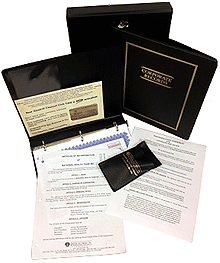
schedule. The Corporate Package is complete and includes Articles
of Incorporation, By-Laws, Corporate Book, Corporate Seal, Preliminary
Name Search, State Filing Fees, and Attorneys Fees. Any Additional
documents or agreements you may order will also be delivered in
your Corporate Records Book
An Important Note about our RUSH SERVICES
We offer two levels of rush service. When you opt for one of our
rush services, we guarantee to promptly deliver your Corporation
to the State for processing, however, if the State is backlogged,
you may experience a delay in receiving your documents. We strive
to have all rush orders ready as soon as humanly possible, however
if time is of the essence you may opt for one of our
Reddi Corps
which are ready for immediate delivery.
OTHER
SERVICES: Please call for pricing and ordering.
Lease Review: Let an attorney check make sure you’re not
stuck with a lousy lease.
Trademark: Protection of a name, symbol, or slogan used by
a business.
Copyright: Protection of literary, dramatic, musical, or
artistic works.
Director or Officer Employment Agreement: Protect your corporation
with an employment agreement.
Corporations also available for immediate delivery, (ready to open
the corporate bank account) from 2001, 2000, 1999, ’98, & ‘97. Spiegel
& Utrera, P.A. also has Private Stock Offerings, Buy-Sell Agreements,
Contracts, Registered Agent Services, Non-Profit Corporations, Articles
of Religion, Limited Liability Companies, Limited Partnerships,
Limited Partnership Agreements, Fictitious Name Registrations, Trademark
Searches, Trademark Registration, Copyright Registrations, and More!
INCORPORATE ONLINE NOW!
SPIEGEL & UTRERA, P.A. is your
one source for business legal services.
Would you rather speak to a lawyer? A Spiegel & Utrera, P.A. associate
is ready to take your call.
|

Spiegel & Utrera, P.A.
Headquarters
Receive by mail our
Spiegel & Utrera, P.A.
Info Packet!

FREE Info Packet
General Counsel Club
Join and be entitled
to Unlimited Access
Unlimited Legal Assistance
One year subscription to our News Letter:
Entrepreneur's Alert®
plus
FREE Advertising on
www.amerilawyer.com and much more!
All for less than 40cents per day

Agreements Prepared & Reviewed
Business Purchase or Sale Agreement, Confidentiality, Non-Disclosure,
Employment, Independent Contractor and hundreds more!
Also Agreements & Leases Reviewed
Click now for your:
FREE Search
Shelf
Corporations
(Reddi Corps)
A Reddi Corp is a corporation that, for many months or even years,
has already been established and is recorded with the Secretary
of State. Corporations are available for immediate delivery with
a Federal Tax ID #
Select your state:
Florida
California
New York
New Jersey
Illinois
Nevada
Delaware |